JournalTradition & PlaceKakheti, Georgia
Why Some Georgian Winemakers Still Bury Their Wine
An old vessel, a working method, and what the ground actually changes.
There are easier ways to make wine. A stainless-steel tank can be cooled at the turn of a dial. Oak barrels can be bought, moved, stacked and replaced. A modern cellar can hold a ferment at whatever temperature a winemaker chooses, and record it every minute.
So why would anyone still set a large clay vessel into the ground, fill it with crushed grapes, and leave it there for months?
The question is worth asking precisely because the usual answer, tradition, explains so little. Plenty of traditions disappear when something more convenient arrives. The qvevri has not. It remains a working method in parts of Georgia, passed down through families and communities and still adapted to contemporary winemaking. And the reasons it survives turn out to be more practical, and more interesting, than its age.
A qvevri is a large, egg-shaped earthenware vessel made for wine. UNESCO, which inscribed the "Ancient Georgian traditional Qvevri wine-making method" on its Representative List of the Intangible Cultural Heritage of Humanity in 2013, describes it as a vessel used for making, ageing and storing wine. In the method it recognises, juice, grape skins, stalks and pips go into the qvevri, which is sealed and buried in the ground so that the wine can ferment for five to six months.
Two details in that description matter. The first is that the vessel does more than one job: the same jar can be where the wine ferments, where it rests on its skins and where it matures. The second is the word buried. It is the vessel that goes into the ground, not the wine in any literal sense. The wine is made inside a jar whose body sits below the surface. The Wine & Spirit Education Trust describes qvevri as buried almost entirely and often coated inside with beeswax. A 2016 study of Georgian wine yeasts by Vigentini and colleagues describes the same object: a large clay vessel placed underground, lined with beeswax, used for macerations that can last up to six months.
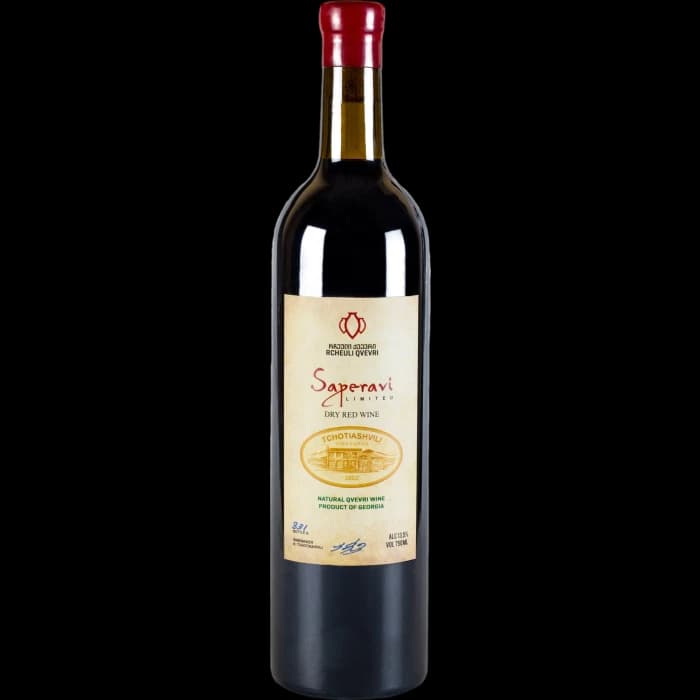
The room that holds them has its own name. Tchotiashvili, the family winery in Kakheti whose Saperavi Rcheuli Qvevri 2020 is the wine associated with this piece, calls its cellar the marani.
UNESCO's recognition is often quoted as if it were a certificate of age. It is something more specific: the recognition of a practice that is still carried out, and of knowledge passed on within families and communities. It was inscribed as heritage that is lived, not as an artefact.
If the qvevri were simply a clay pot, it could stand on the floor like any other vessel. Burying it changes something real, and it is worth being exact about what.
Soil responds slowly to the air above it. Experimental work on underground wine cellars, rooms built into the ground for ageing wine rather than qvevri themselves, has measured this directly. In a 2015 study published in Energy and Buildings, Tinti and colleagues monitored the temperatures around one underground cellar and found the variation below ground to be substantially smaller than the variation outside. The ground does not refrigerate. It damps.
A vessel buried almost to its neck sits in that damped environment. WSET describes the surrounding earth as a natural thermal buffer that keeps temperatures relatively stable through fermentation and maturation. A 2013 study of wines made by the Kakhetian method, by Capece and colleagues, likewise describes qvevri buried in the soil, with fermentation proceeding spontaneously in the presence of the grape solids.
That is roughly as far as the evidence goes. Measurements from a single cellar describe that place and that soil, not every qvevri in Georgia. Depth, soil, climate, the size of the vessel and the heat produced by fermentation itself all play a part. What can be said is simpler and more useful: the earth does not improve wine through some special property of its own. It changes the thermal conditions in which wine is fermented and aged, slowly and without machinery.
Seen that way, burying a vessel is not a ritual. It is a form of temperature management that predates the thermostat, and still works.
What happens inside the vessel depends on how it is used, and Georgia has more than one way of using it.
In Kakheti, the method is defined by how much of the grape goes in. WSET describes white grapes fermenting with their skins, seeds and, in many cases, stems, and staying in contact with those solids for several more months after alcoholic fermentation is complete. In Imereti, a much smaller proportion of skins and seeds is used, and stems are usually left out. The solids have a Georgian name, chacha.
Tchotiashvili describes its own practice of the Kakhetian method in some detail. The grapes are processed in qvevri with their skins, pips and stems. After alcoholic fermentation, its white wines remain on the skins and pips for seven to eight months, its red wines for three to four. The clearest wine is then drawn off into another qvevri, where its maturation begins. Only after that is it bottled.
That describes how the winery works, not a particular bottle. But it shows what the vessel is for. A qvevri is not simply a container that happens to be made of clay. It is a place where fermentation, extraction and maturation can follow one another, with the wine in contact with the whole fruit for months, at a temperature the ground helps to keep in check.
At this point, most writing about qvevri reaches for a number: eight thousand years.
The number is not invented. In 2017, a team led by Patrick McGovern published in the Proceedings of the National Academy of Sciences a chemical analysis of pottery from two Neolithic sites, Gadachrili Gora and Shulaveris Gora, about 50 kilometres south of Tbilisi. Residues in jars dated to around 6000 to 5800 BCE contained compounds associated with grapes, and the authors concluded that the jars probably held wine. They describe it as the earliest biomolecular archaeological evidence for grape wine and viniculture from the Near East.
What the study does not show matters just as much. The authors state that no evidence has yet been found of how those jars were positioned, or whether they were partly or fully buried. And the same paper places the earliest archaeological evidence for qvevri themselves far later, in the Iron Age, around the eighth and seventh centuries BCE.
So the story is older than the cliché in one sense and younger in another. Wine in what is now Georgia goes back, on the strongest current evidence, around eight thousand years. The earliest documented qvevri evidence appears much later, in the eighth to seventh centuries BCE. Between the two lies a long stretch that the evidence does not fill. "Eight thousand years of buried wine" collapses those facts into a slogan. The accurate version is less tidy: very early wine, a vessel that came much later, and a method still recognised as a living practice today.
The family behind Tchotiashvili, according to its own account, traces its winemaking in the Alazani Valley to the beginning of the eighteenth century, when an ancestor built a house in the village of Saniore, near the Lopota river. It describes harvests and qvevri winemaking continuing there from year to year, and itself as the sixth generation to carry them on.
What it has built recently says more than what it inherited. In 2002, the brothers Kakha and Ucha Tchotiashvili began adding rare grape varieties to their vineyards. Their original cellar is, in the winery's description, an on-ground building holding 22 Kakhetian qvevri of about two tonnes each. In 2019 they added a cellar three metres below ground, with 23 qvevri: ten Kakhetian and thirteen Imeretian. The winery describes that mix as an experiment, a way of observing and studying wine technology. For the same purpose it uses Caucasian and French oak barrels, for both fermentation and ageing.
That is not a museum. It is a working cellar comparing vessels, regional traditions and materials side by side, in which the qvevri is one option among several and stays in use because it keeps being chosen.
Which brings us to the bottle.
The Saperavi Rcheuli Qvevri 2020 is, in the producer's words, a dry red wine produced in qvevri using the traditional Kakhetian method. That much is documented. A good deal else is not, at least not in the winery's public material. It does not say how many months the 2020 spent in qvevri. It does not say whether it saw any oak. It does not say whether it was made in the original cellar or in the underground one finished a year earlier, or whether the qvevri of the original cellar are set into its floor. It does not say, in other words, whether the vessel that held this particular wine was buried.
It would be easy to fill those gaps with the story the subject invites. We have not. The winery tells us how its method works. Its public material does not tell us everything about this vintage. That distinction matters, because assuming every detail of a wine from the general romance of its method is how good stories become unreliable ones.
Why, then, do some Georgian winemakers still bury their wine?
Not because the practice is old. Plenty of old practices have gone. The qvevri survives because it still makes sense as a tool. Burying a vessel changes the thermal conditions of fermentation and ageing without a compressor. The method allows the solids of the grape, the skins, the seeds and in Kakheti the stems, to stay with the wine for months. A single vessel can serve from the first days of fermentation to the end of maturation. None of this is magic, and none of it requires nostalgia.
What it requires is a decision. At Tchotiashvili, that decision sits beside oak barrels and two kinds of qvevri, in a cellar built in 2019. That is the clearest sign the method is contemporary: not that it has lasted, but that people with other options keep choosing it.