JournalPlace & ClimateMendoza / High-altitude vineyards
Why Some Winemakers Are Moving Uphill
Altitude is no longer just a number on a technical sheet.
Over thirty years, the size of Mendoza's vineyard barely changed. In 1990 the province had 146,709 hectares of vines. In 2021 it had 148,996: an increase of 1.6 per cent, according to Argentina's Instituto Nacional de Vitivinicultura (INV).
Inside that almost flat line, one part of the province moved.
In the Uco Valley, the high oasis south-west of the city of Mendoza formed by the departments of Tupungato, Tunuyán and San Carlos, the area under vine grew from 8,112 hectares to 29,139 over the same period. That is an increase of 259.2 per cent. In 1990 the valley held 5.5 per cent of Mendoza's vineyards. By 2021 it held 19.6 per cent.
The INV is unusually plain about where that growth went. In its 2022 report on the valley, it states that the development of high-altitude viticulture drove the expansion of the oasis onto the high ground of the piedmont, the sloping land that rises from the valley floor towards the Andes. Moving uphill, in Mendoza, is not a figure of speech. It is a description of where the vines were planted.
It is also easy to tell the story too simply.
The 1990 figure is a reminder that the valley was not empty when this began. More than 8,000 hectares were already planted. What changed over the following three decades was less the discovery of a place than the direction of its growth: upwards, onto ground the INV describes as stony and low in fertility, where rounded stones are mixed with coarse sand and the soils drain freely.
Which raises the more interesting question. If growers were not simply finding new land, what were they looking for, and what did they get?
The starting point is temperature. Catena Zapata, which planted in Gualtallary in 1992, describes the relationship in two clauses: as one climbs the Andes, it says, average temperature decreases and the difference between day and night temperatures increases. For the valley as a whole, the INV gives a daily thermal range of around 15°C: temperate days, very cold nights.
Light changes too. A 2022 review of high-altitude viticulture by Arias and colleagues, published in Frontiers in Plant Science, reports that ultraviolet-B irradiance in Mendoza's high vineyards can reach 40 microwatts per square centimetre on summer days, against around 15 at sea level. A separate study of four sites across Mendoza, from Agrelo at 950 metres to Gualtallary at 1,350, found Gualtallary the coldest of the four and recorded higher UV-B there than in Agrelo.
What does that mean in the vineyard? Some consequences are well described. According to the 2022 review, lower temperatures slow the breakdown of malic acid in the grape, which can raise the acidity of the must. Ripening tends to be delayed: studies from several high-altitude regions, gathered in the same review, report later harvests at higher sites.
Other consequences are more specific than they are often made to sound. Much of the Mendoza research on solar UV-B has been carried out on Malbec, where it has been linked to the accumulation of phenolic compounds in the skins of a red grape. That work is valuable. It is not, on its own, a description of what altitude does to Chardonnay, and it should not be borrowed as one.
Height also has costs, and the same review is clear about them. By lengthening the period in which vulnerable parts of the vine are exposed to the cooler part of the season, altitude can increase the risk of frost and hail. Strong radiation before véraison can cause sunburn in both red and white varieties. The INV, describing the valley as a whole, lists frost, hail and the zonda wind as factors that frequently cause significant losses.
Altitude, in other words, is not a refuge. It is a different set of conditions, with its own advantages and its own hazards.
Gualtallary, in the department of Tupungato, is where those conditions become most concrete. The vineyards discussed here sit between 1,350 and 1,470 metres, several hundred metres above the town of Tunuyán, which the INV places at around 900.
In 1992, Nicolás Catena planted the Adrianna vineyard there, at around 1,450 metres. Catena's own account is that he "dared to plant vines where no one thought they would ripen." The doubt is part of the point. In Catena's telling, the attraction of the site was its temperature.
Then came the spring of 2022.
In October and early November, frost struck Argentina's vineyards. Catena's harvest report describes three frosts in October and one in early November, affecting every vineyard area from Patagonia in the south to Salta in the north.
On the simple model, in which higher means colder and colder means more frost, the highest vineyard should have suffered most. Catena reports the opposite. Adrianna, at the highest altitudes it farms, saw almost no effect from the frost. Nicasia, in Altamira, was mildly affected, with a reduction in yields. Angélica Sur, in El Cepillo at the southern end of the Uco Valley, had the most dramatic reduction.
One vintage, reported by one producer across its own vineyards, does not make a rule, and the report does not explain the difference. It does not need to. It is enough to show that the relationship between height and danger is not a straight line. Altitude changes the risk profile. It does not simply add to it.
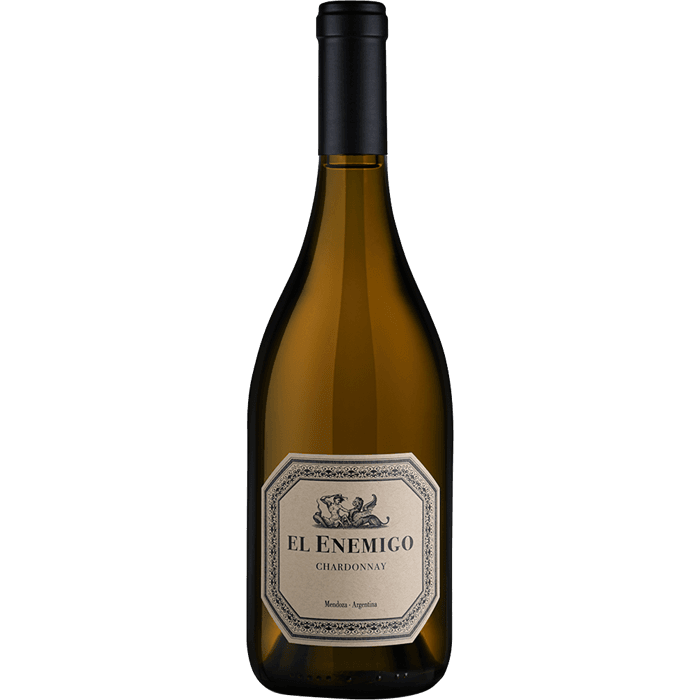
El Enemigo Chardonnay 2023 comes from this landscape: Gualtallary, Tupungato, at 1,470 metres, on soil the producer describes as deep, calcareous and rocky. The winemaker, according to the technical sheet, is Alejandro Vigil.
The vineyard supplies the conditions. Almost everything else on the sheet is a decision. The wine ferments with wild yeast in 500-litre French oak barrels, at a maximum of 18°C, over forty days. It then spends twelve months in 500-litre French oak, "with veil", in the sheet's own words.
None of those choices is dictated by altitude. A cool site can deliver grapes with high natural acidity. It does not choose the size of a barrel, the origin of the yeast or whether a wine is left beneath a veil.
The sheet's harvest report places the vintage in its regional context. It describes the October and November frosts as causing a generalised reduction in yields, followed by a very dry season with temperatures slightly on the warm side, and a harvest two to four weeks earlier than usual. It describes the 2023 wines as having high natural acidity and low alcohols. Those are statements about the vintage in Mendoza, as El Enemigo reports it, not about the frost history of a single vineyard. They are also a reminder that the year is part of the equation too.
"Moving uphill" can sound like a pursuit of altitude for its own sake, as if the number on a label were the achievement. The evidence describes something less tidy and more interesting: an exchange. Growers who climb trade warmer ground for cooler nights, stronger light, slower ripening and poorer, stonier soils. They take on different hazards and, as 2022 showed, are sometimes spared others.
There is also a forward-looking reason the subject is attracting attention. The 2022 review notes that higher-altitude regions have become a recognised alternative for maintaining high-quality viticulture of traditional varieties in future climate scenarios, mainly because of their lower mean temperatures. That is not a prediction about Gualtallary. It is a sign that the question of where vines belong is being asked again.
Higher is not better. It is different, measurably so, and in ways that can still surprise. What the slopes of the Uco Valley show is not that altitude solves the problem of making wine in Mendoza. It is that climbing changes the terms of the equation.