JournalPlace & PleasureManduria, Puglia
The Art of Instinct: Red Earth and the Pleasure of Es
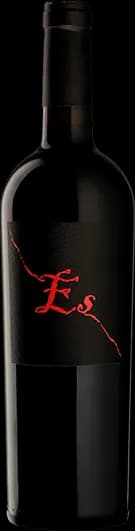
A Primitivo named after Freud’s word for instinct, from Puglia’s red earth and bush vines, made around one principle: pleasure.
Some wines begin with a place: a slope, a village, a name on a map. Others begin with an idea. Es begins with instinct.
The name comes from Sigmund Freud. Es, in his German, is the part of the mind that wants before it reasons, the drive that English translations call the id. Gianfranco Fino chose the word deliberately. His own description of the wine speaks of instinct and unbridled passion, and of a wine submitted to one sole principle: pleasure.
It is an unusual way to introduce a wine, and a candid one. Most labels ask to be understood. This one asks first to be felt.
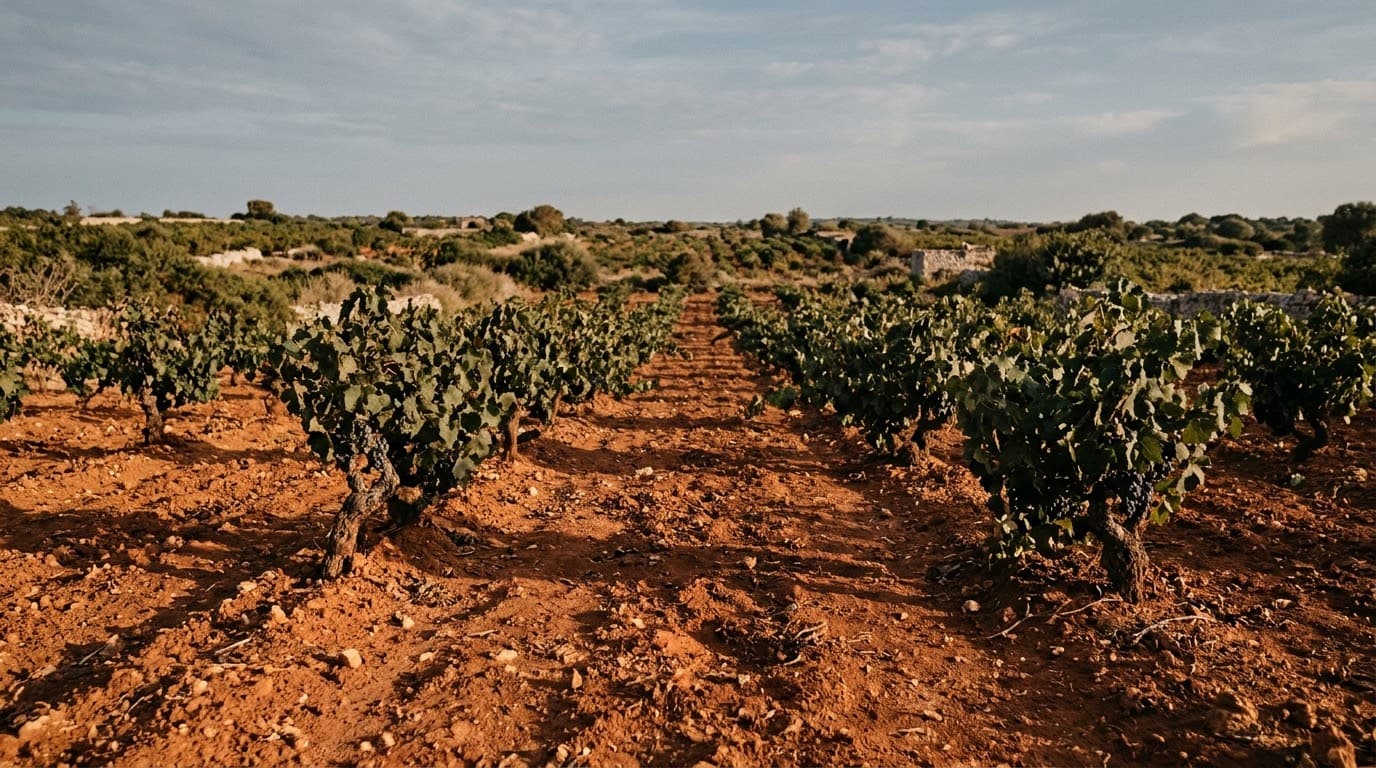
Still, instinct has to grow somewhere, and here it begins with the colour of the land. Es is a Primitivo from the countryside around Manduria and Sava, in Puglia, the heel of Italy. The estate describes its soil plainly: red, with limestone and clay, under the warm Apulian sun and a breeze that comes in from the Ionian Sea. Gianfranco Fino classifies the wine as Salento Primitivo IGT.
The vineyards are flat, and the vines are trained as alberello: low, free-standing bushes, in what the estate calls the small bush pugliese system. It is a traditional way of growing vines in the south, and on this estate the work is done by hand. The producer also says it sets out to save old vineyards and keep their features alive, a commitment to continuity as much as to any single wine.
For a wine named after instinct, a great deal of the work behind it is deliberate. The grapes are picked by hand at first light at the end of August, placed in cases and taken to the cellar in refrigerated trucks. Destemming waits until the afternoon, once the fruit has reached the right temperature.
In the cellar the bunches are sorted, destemmed and gently crushed, then left on their skins for two to three weeks in stainless steel tanks. Twice a day the juice is drained off and returned over the skins, a technique known as délestage. The skins are pressed in a vertical hydraulic press. The wine spends about nine months in 228-litre French oak barriques and around six more in bottle before release, and it is bottled without fining agents.
None of these steps is unusual on its own. What stands out is the attention given to the moments that are easiest to hurry: the hour of picking, the temperature of the fruit, the time on the skins.
Primitivo is a grape of ripeness. Its name is usually traced to its early ripening, and at Gianfranco Fino the harvest comes at the end of August. Ripeness is the starting point here, not the whole story.
Tasting the 2023 in August 2025, Falstaff’s Othmar Kiem and Simon Staffler noted ripe plum and cedar, an enveloping texture and noticeable tannins, with a long finish. Read together, those observations describe a wine of ripeness and structure: generous fruit, given a frame.
A tasting note can say what a wine smells like. It is less good at saying why the wine exists. Es is a reminder that a wine can begin with a feeling and still be made with care: a name borrowed from Freud, red soil, bush vines and a harvest that starts at first light.
Pleasure, here, is not the opposite of seriousness. It is the point.
Some things are worth knowing. Others are worth taking the time to feel.