Wine Moment
The Steep Side of Ribeira Sacra
Where the vineyard stops being a field and becomes a slope.
- Place
- Amandi, Ribeira Sacra
In most wine regions, a vineyard is something you walk across. In Ribeira Sacra, much of it is something you climb.
The appellation follows two rivers, the Miño and the Sil, through the south of Lugo and the north of Ourense. Where their valleys close in, the vines are not spread over open ground. They are stacked up the sides of the valley, on terraces built to hold soil on slopes that, by the appellation’s own account, can reach a gradient of 100 per cent.
That number changes what a vineyard is. A field can be worked by machine. On terraces this steep, the work falls to people: in the appellation’s words, to the hands, arms and backs of those who grow the grapes.
This is what “heroic viticulture” means in practice. It is not a claim about courage but a description of ground too steep for anything else. Ribeira Sacra is among the few Spanish appellations entitled to the seal of CERVIM, the international body for steep-slope viticulture.
Amandi, one of the appellation’s five subzones, runs along the Sil. Its vineyards face largely south and are planted on slate above the river. The Rodríguez family have grown grapes here for generations, as colleiteiros: growers who made wine from their own vines.
Taken together, these choices describe a way of working in which the cellar follows the vineyard.
In 1991 they founded their own adega, in Sober, and put a name of their own on the bottle. They chose Guímaro, the nickname of Pedro Rodríguez’s grandfather. It means “rebel”.
The winery did not begin with an idea. It began with a parcel.
Finca Meixemán is a single plot of about 1.2 hectares of old Mencía vines, at roughly 400 to 450 metres, on schist and granite. It is the family’s original vineyard, the one from which the adega grew.
On a plain, 1.2 hectares would be a modest field. In Amandi, land is measured less by its area than by the work it takes. The grapes are picked by hand and trodden by foot, then fermented in open wooden vats with a long maceration and aged mostly in used barrels. The wine is bottled without fining or filtration.
Taken together, these choices describe a way of working in which the cellar follows the vineyard.
The label reads Finca Meixemán, Ribeira Sacra. What the bottle holds is a small piece of steep ground, worked largely by hand, by the family whose winery began there.
That is the steep side of Ribeira Sacra: not a view, but a gradient, and the work it asks for.
The bottle
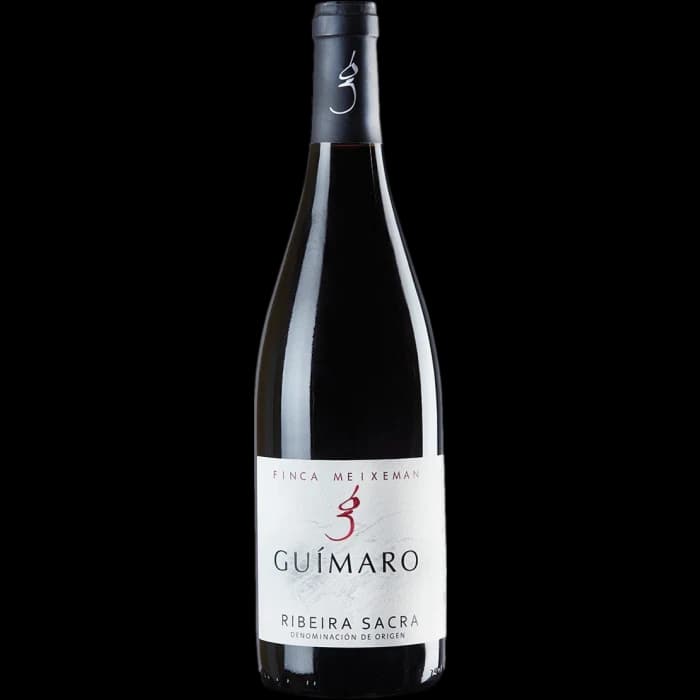
Guímaro Finca Meixemán 2023
Read the Wine Story →